
What does it mean to dance?
This was a question I brought with me to Kenya and is one of the life questions I am constantly exploring. Having grown up in a rural Indigenous community in the Philippines, dance meant as an expression of culture and tradition. Dance meant learning Filipino folk dances or engaging in ritual practices to celebrate significant community events.
I carried this with me and have since developed an interest in how other cultures and individuals interpret dance. Throughout my time at Wesleyan, I’ve seen how dance can take many forms: a community performance in El Paso, Texas, raising awareness about water scarcity, or dancing with the University President after Election Day to celebrate hope. This curiosity of how dance is interpreted traveled with me to Kenya, and along with this is the idea of the ubuntu philosophy: i am because we are.
To answer this question, my process involved engaging with various communities and individuals in Kenya. At its core, my initial plan was to connect with Cheza Cheza, a nonprofit organization that uses dance to support the development of Kenyan youth in vulnerable communities and to help address the ongoing mental health crisis in the region. I also looked into Afrocure as well as students and mentors of the Kenya Education Fund.
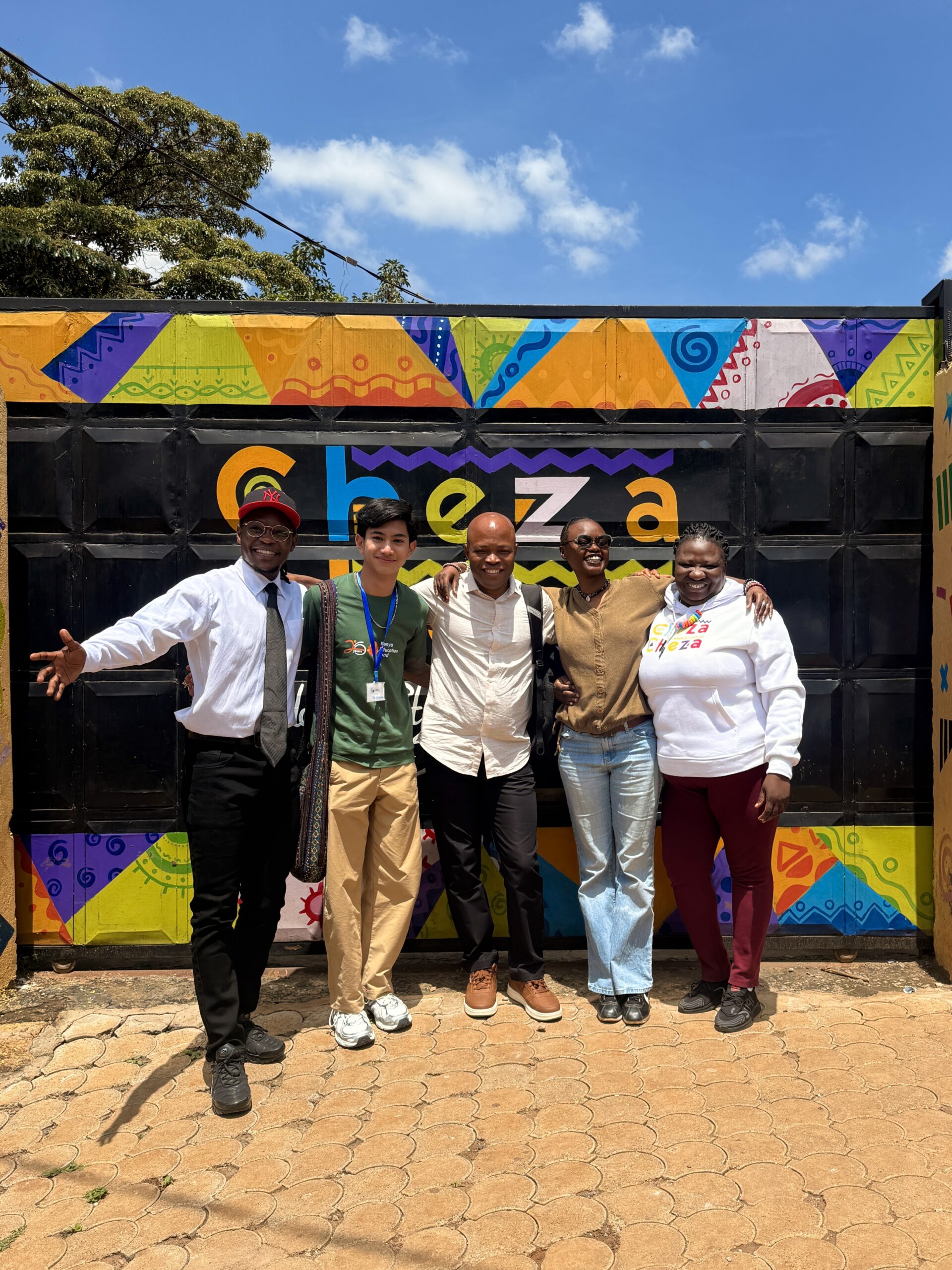
Together with Professor Iddi, we went to Cheza Cheza in Kibera to meet Collins, one of the co-founders of Cheza Cheza. He gave us a tour of the space with its open area, dance studio that can be turned into a classroom, and the headquarters with rooms for all Cheza Cheza staff which we also had the privilege of meeting. Right off the bat, what I noticed was the big and colorful Cheza Cheza sign on their gate. I spent a lot of time noticing the materiality of the space – the murals, the walls, book shelves, office doors, and more, and what those colorful elements meant to the experience of the kids and staff in Cheza Cheza. This not only brightens up the space but it signals the playfulness and safety aspect of the space that reflects the mission of the organization which is to create a safe artistic environment for Kenyan youth in vulnerable communities like Kibera.
We also spent a lot of time talking about the programs in Cheza Cheza and the curriculum that they use to approach their work. Every class in Cheza Cheza has a set of 7 structures or elements.
1. Circle of Trust
2. Emotion check-in
3. Life skills
4. Warm up
5. Choreography
6. Cooling down
7. Reflection
The classes are based on an outline of a dance movement therapy session. This means that all class sessions are physically structured in a circle. Although I have not fully witnessed this in person in Cheza Cheza, I recognize the importance of this circle as I have observed this practice in my West African dance classes here at Wesleyan. This curriculum is also something I want to borrow and carry into my own work as I explore different approaches to teaching dance and what should be included in a dance class. And how we can view dance beyond staged performances.
Mental health disorders among adolescents represent a critical global public health challenge, with particularly severe impacts in low- and middle-income countries where treatment resources remain scarce. In Kenya, studies suggest that up to 37% of adolescents experience depression symptoms, yet comprehensive data on youth mental health challenges remain limited [2]. The establishment of a national taskforce in 2019 [3] highlighted the urgent need for large-scale surveys to inform resource allocation and intervention planning, but few subsequent comprehensive studies have been conducted.
Kenyan adolescents face unique psychosocial challenges including poverty, educational pressures, family disruption, exposure to violence, and emerging stressors such as climate change and digital technology impacts. Traditional Western-developed mental health assessments may not adequately capture culturally specific expressions of distress, necessitating validation of both international and culturally adapted instruments in sub-Saharan African contexts.
This is one of the primary why’s of Cheza Cheza. Talking to Collins for a brief amount of time, for him, to dance is to address this bigger issue of mental health and inequality in vulnerable communities like Kibera by creating a safe artistic community that aims to build strong minds.
As of today, this is the current data on the impact of Cheza Cheza.
My experience with Cheza Cheza, KEF, and Kenya more broadly reflects the idea that dance is, and will continue to be, a tool for social justice. By shifting our perspective on how dance should look like and why individuals and communities need it, we can understand that dance has the power to level the playing field so that each player has the equal opportunity to win. That in order for us to break the binaries and hierarchies of society, we first need to find the truth and strength in our own bodies. Because in order for us to be or to get somewhere, we must first act—we must move.
Whether it’s learning Filipino folk dance, queering your body in bedrooms and safe spaces, raising awareness on water scarcity in El Paso, Texas, or simply dancing at the end of your KEF CREW workshop – dance becomes this tool of finding your identity – both individually and collectively. Drawing from the concept of ubuntu, dance becomes a way through which we become ourselves and each other.
As a continuation to this project and ongoing conversation on how people and communities define dance, I am hoping to come back to Kenya this summer and start an internship program at Cheza Cheza which includes a piece of research in dance and impact,learning more about their programs and eventually shadowing their mentors, as well as to look for other avenues on how dance is being used in Kenya.
