
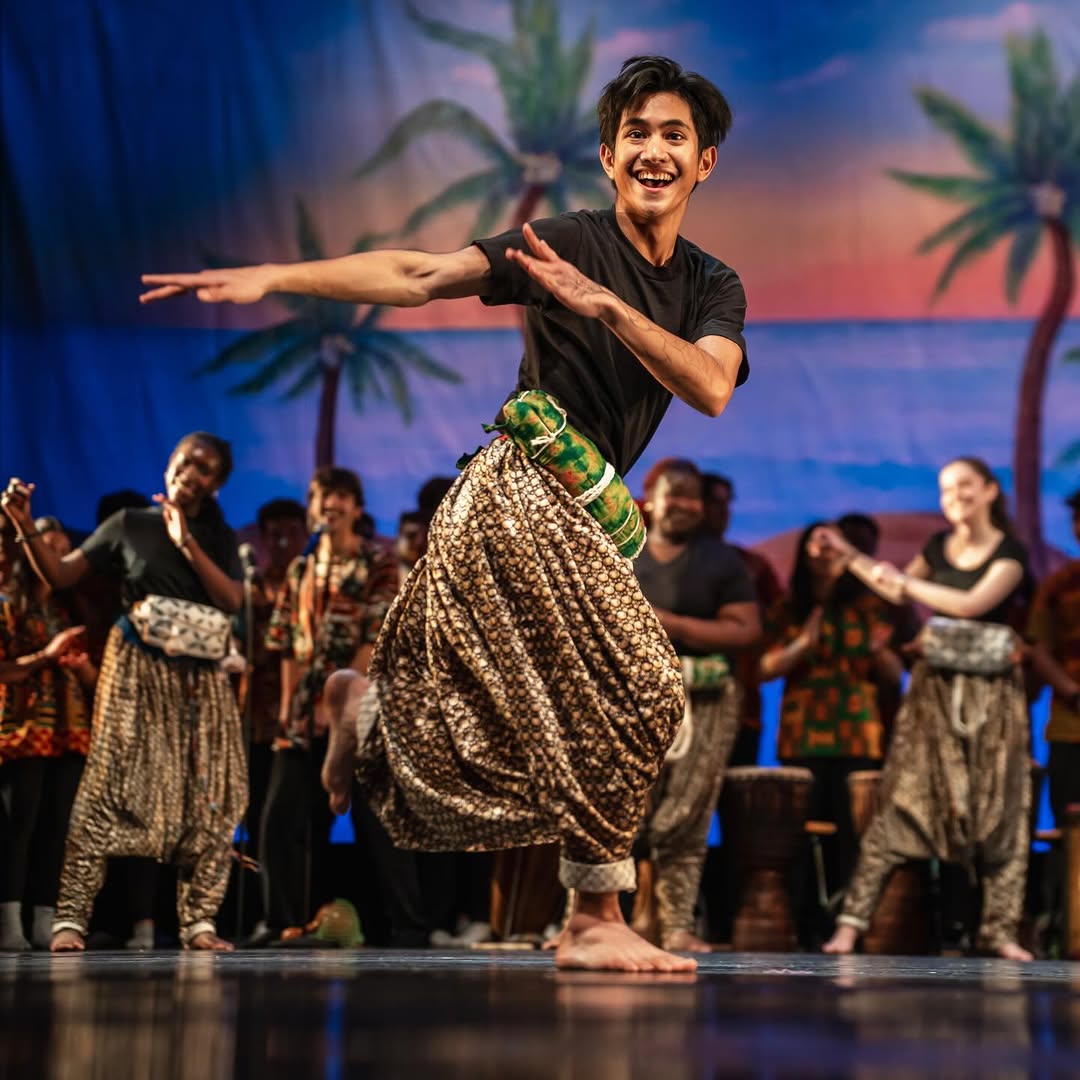
I did not take the West African dance class my first semester at Wesleyan because I was scared. I was scared that me not being West African would make me an individual that appropriates culture. That it was not the space for me. The thing is, before coming to Wesleyan, the idea of intercultural competence was almost non-existent for me as I’m used to being in spaces with people who look and speak like me. I was not prepared for a more diverse environment. But after my first semester at Wesleyan and having to connect with people of various backgrounds than me, I eventually took the class my second semester. And I remember coming into the cross street studio with nothing but a question – is it ok for me to be taking a West African dance class?
Professor Iddi welcomed me so warmly that I almost forgot about the question I brought into the class. It was only after a week of classes that I had the courage to ask the question not just to Iddi but in front of the whole class, I almost felt as if I was completely ignorant (spoiler: but that’s ok! It is through being uncomfortable that we grasp the true value of intercultural competence). I remember Iddi answering my question with much grace and respect, telling us that taking a West African dance class is not necessarily appropriation. When you come into the class, your goal is not to mimic the style and the culture, instead, you take the style out of its original context and recontextualize it into a movement class. It wasn’t about being West African or dancing like one – it was about the value and the learning aspect that comes with it that we strive for.
This isn’t the only situation where I battle this idea of authenticity. When I was visiting Canada over winter break, I introduced myself as an indigenous person from the Philippines and one of the people I was with asked me why I don’t look like one. I wasn’t really sure what they meant or if there’s a standard for how an indigenous person should look like but if there’s something I took from that encounter, it is that authenticity, specifically the authenticity test, is nonprogressive. Thus, there is a need to focus on sincerity beyond authenticity.
This is the argument that anthropologist John L. Jackson has mentioned in his work Real Black: Adventures in Racial Sincerity. Authenticity can be problematic in its nature of authenticating something as if there is a universal standard or a set of external criteria. This is true with the ways in which our world is so diverse that it is almost impossible to categorize people, culture, and even places. Instead, we should focus on sincerity as it allows more flexibility. Someone might not “look authentic” according to the scripts, but still be sincerely expressing their identity which recognizes that identity is dynamic, negotiable, and sometimes contradictory.
I was able to observe this by embodying the values that I took from being an indigenous youth who grew up in a rural province and applying them to the world and context that I am already in right now which is the United States. I didn’t need to be West African to take a dance class, I just needed the proper intentions to be in it.
Sincerity privileges intent and not just content. It is through intentions, not just looks, that we get to prove the trueness of someone or something. It is through sincerity beyond authenticity that we see people as more than “authentic objects” and recognize the possibility of sincere identity even when scripts of authenticity are not fully met.
